News, views, and updates for the APLS community of practice.
Board Chair's update
PAC 2026 in New Zealand
The role of self-awareness in high performing teams
Behind the debrief
Launching a PLS Community of Practice
Major haemorrhage in paediatric trauma
From the CEO
COMMITTEES
Course Development Committee
Faculty Development Committee
International Programs Committee
PLS Course Committee
BITESIZE
A round-up of other APLS news
On behalf of APLS New Zealand, we're delighted to invite you to Te Awa Ora: Paediatric Acute Care (PAC) 2026 Conference to be held at the beautiful Te Pae in Ōtautahi, Christchurch, 15-17 October 2026.
It’s very exciting to be hosting the very first ever Paediatric Acute Care Conference in Aotearoa New Zealand.
The theme of the conference for 2026 Te Awa Ora, “the living river“ takes inspiration from the braided rivers of Canterbury that meander through Ōtautahi. Te Awa Ora in Maori symbolises life, flow and connection. The river is essential; to life and health.
Ko au te awa, ko te awa ko au
The river is healthy. The people are well.
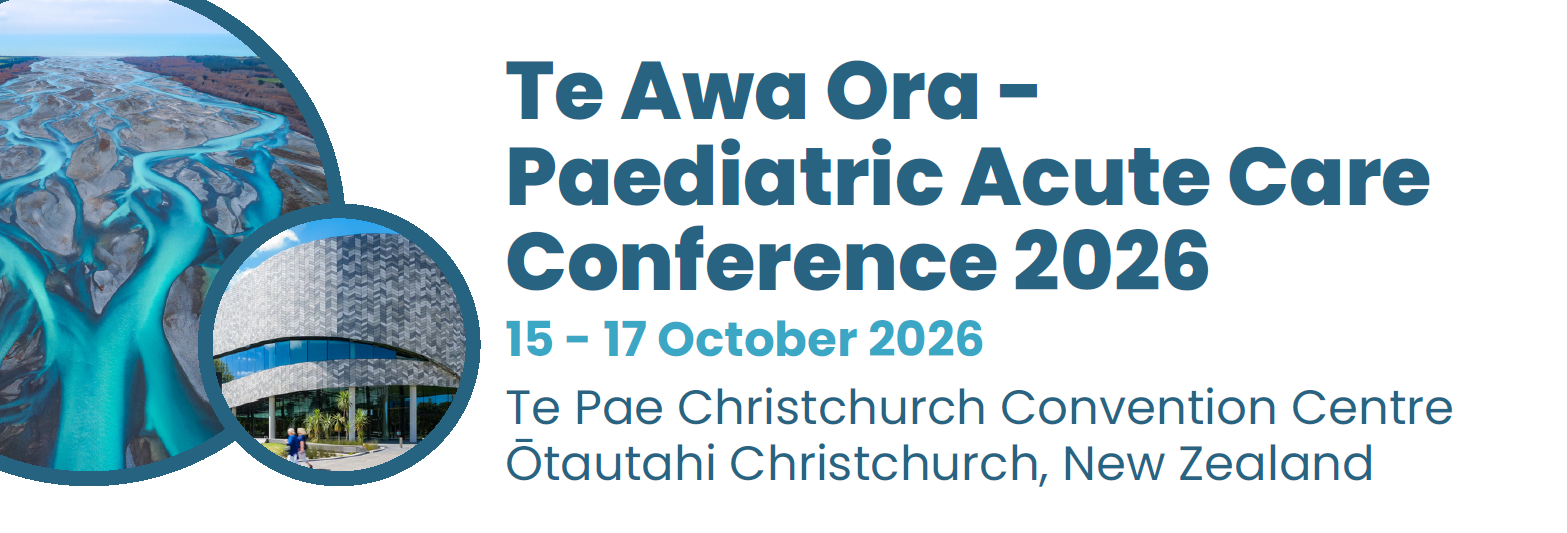
This name Te Awa Ora represents the dynamic ever-flowing nature of paediatric care shared across the Tasman and amongst paediatric communities through a process of weaving knowledge streams.
With a program including lectures and workshops the conference aims to deliver an exciting academic program along with a rich cultural experience and diverse entertainment options for some fun and networking.
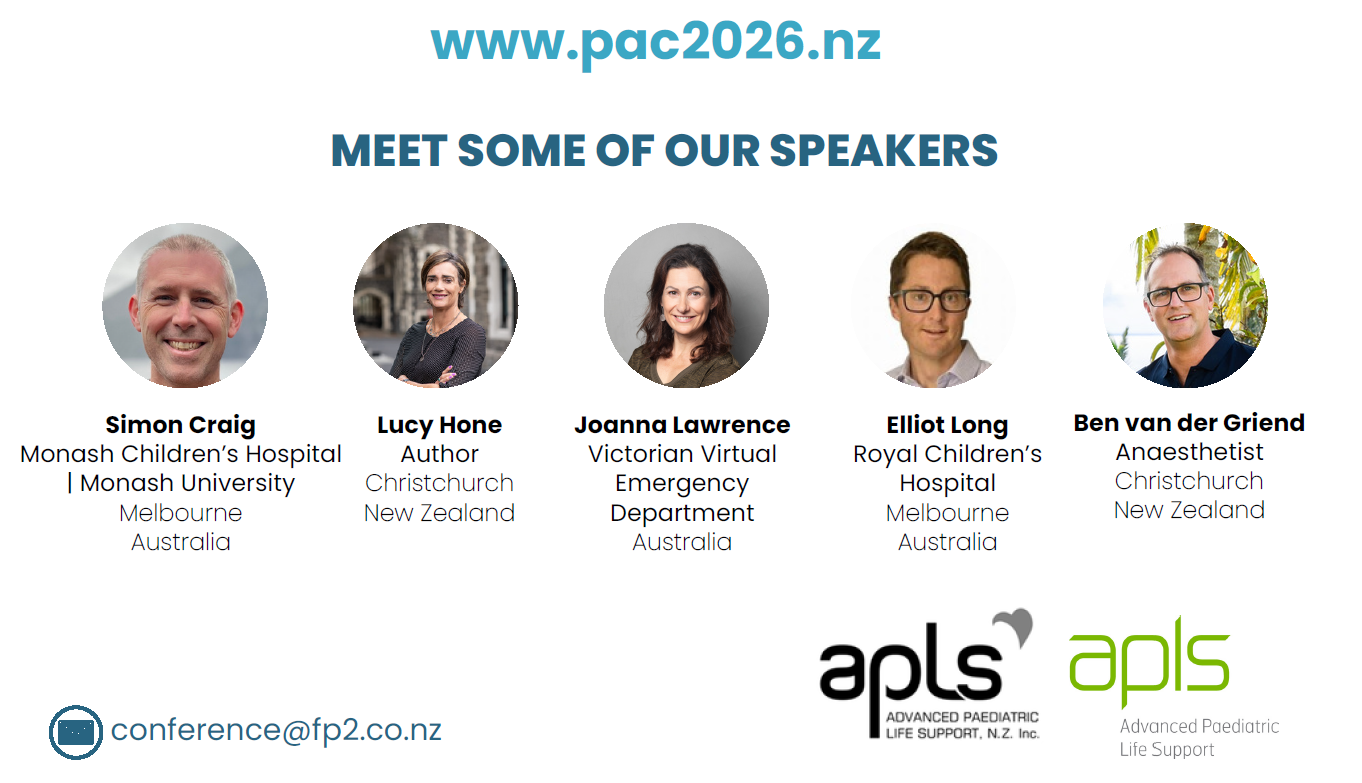
Conference registrations are now open. Confirmed speakers so far include Lucy Hone, Simon Craig, Christine Beasley, Joanna Lawrence, Elliot Long, Gabrielle Nuthall and Ben van der Griend. Submissions are also open for abstracts for oral and poster presentations at the conference.
Visit pac2026.nz for registration, conference and program information. Nau mai, haere mai ki Ōtautahi, Aotearoa with a specially warm welcome to our colleagues from across the Tasman for a memorable few days.
Damaya Rasanathan
On behalf of the Conference Organising Committee
PAC 2026 Conference
On a daily basis people work around “difficult” colleagues, leading to hidden fractures, reduced communication, and patient safety risks. Without external feedback, our own blind spots go unchecked as reflection becomes "a database of one".
So how do we train ourselves to become better at self-reflection? Staff wellbeing specialist Dr Liz Crowe tackles the subject of self-awareness in this outstanding keynote session from the 2024 APLS Paediatric Acute Care Conference.
Debriefing in both clinical and sim training environments is common. But how do we know if our debriefs are effective?
As recommended by the APLS Education Team, this paper examines "debriefing the debrief" – 8 tips to help your team become better debriefers.
You can read Growing as debriefers, together: eight tips for launching and sustaining an online Meta-Debrief Club here, and listen to an episode of the Simulcast Journal Club which explores this and other fascinating new papers here.
"It's a great paper, practical and not a lot of jargon", explains APLS Educator Jane Stanford. "In paediatric acute care we debrief all the time, but there's no one correct way to run a debrief – it's always context dependent." The paper explores a “meta-debriefing” approach, reviewing and discussing debriefs to build insight and refine technique. While formal clubs may not suit every setting, the principle can be applied everywhere: creating space to observe and improve how we debrief, not just what we teach.
The papers discussed in the Simulcast episode emphasise two key themes relevant to APLS courses: psychological safety and a concept called 'educational alliance'. When learners trust that feedback is supportive, deeper learning follows. "Building an 'educational alliance' means that when someone trusts that you've got their interests at heart, and anything that you say to them is because you want the best for them, we build a sense of safety," says Jane. "Ultimately it's about creating a space where we all come to learn."
It’s a reminder that debriefing is a skill developed over time. As Jane puts it: “The more you know, the more you realise there are gaps… and that’s where the learning starts.”
Paediatric major haemorrhage is rare, high-stakes, and persistently difficult to manage. Not least because most protocols are adapted from adult trauma rather than designed for children.
A shift in thinking is underway: away from focusing on transfusion as the solution, and back toward haemorrhage as the problem. In practice, variability in language and approach can still lead to inconsistent care, delayed correction of coagulopathy, and a tendency to “give a bit of everything” rather than treat what’s actually needed.
Despite advances in adult practice, paediatric care has lagged in adopting viscoelastic testing (ROTEM/TEG/ClotPro), with barriers including low case frequency, limited familiarity, and the cognitive load of interpreting results during resuscitation. Emerging guidelines (alongside local experience and the FEISTY Junior study) support a more targeted approach, particularly around early recognition and treatment of low fibrinogen.
So how do we move from protocol-driven to precision resuscitation in children? Shane George, clinical lead for children's critical care research at Gold Coast Health, explores the evolving approach to paediatric major haemorrhage in this practical and thought-provoking PAC 2024 session.
Over the past year, the Course Development Committee (CDC) has met every few months to review and discuss your feedback and to consider new evidence and ways to strengthen the learning experience for participants.
This has resulted in a number of changes to both the content as well as the structure of of the 3 day course.
Details on these changes may be found in the July 2025 Faculty Update, the December 2025 Faculty Update and in the Key Course Content Clarifications 2025/2026, which you can access via the Faculty Noticeboard at the top of the My APLS page. The Faculty Noticeboard is a hub for teaching and course content updates, so be sure to review before joining a faculty.
Some of the key updates in the new course include:
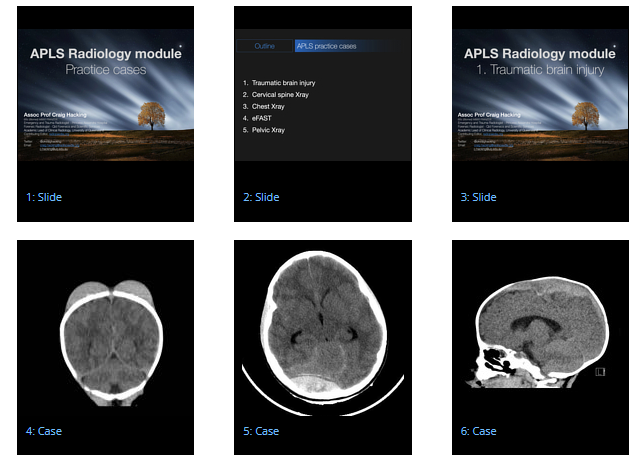
1. A major addition to the pre-course e-learning package in the form of an online workshop on Radiology, produced in collaboration with Radiopaedia
2. Online learning updates for consistency with recent guidelines
3. A new Faculty-only version of the online learning package which allows for free navigation, so you can quickly skip to the content you'd like to review
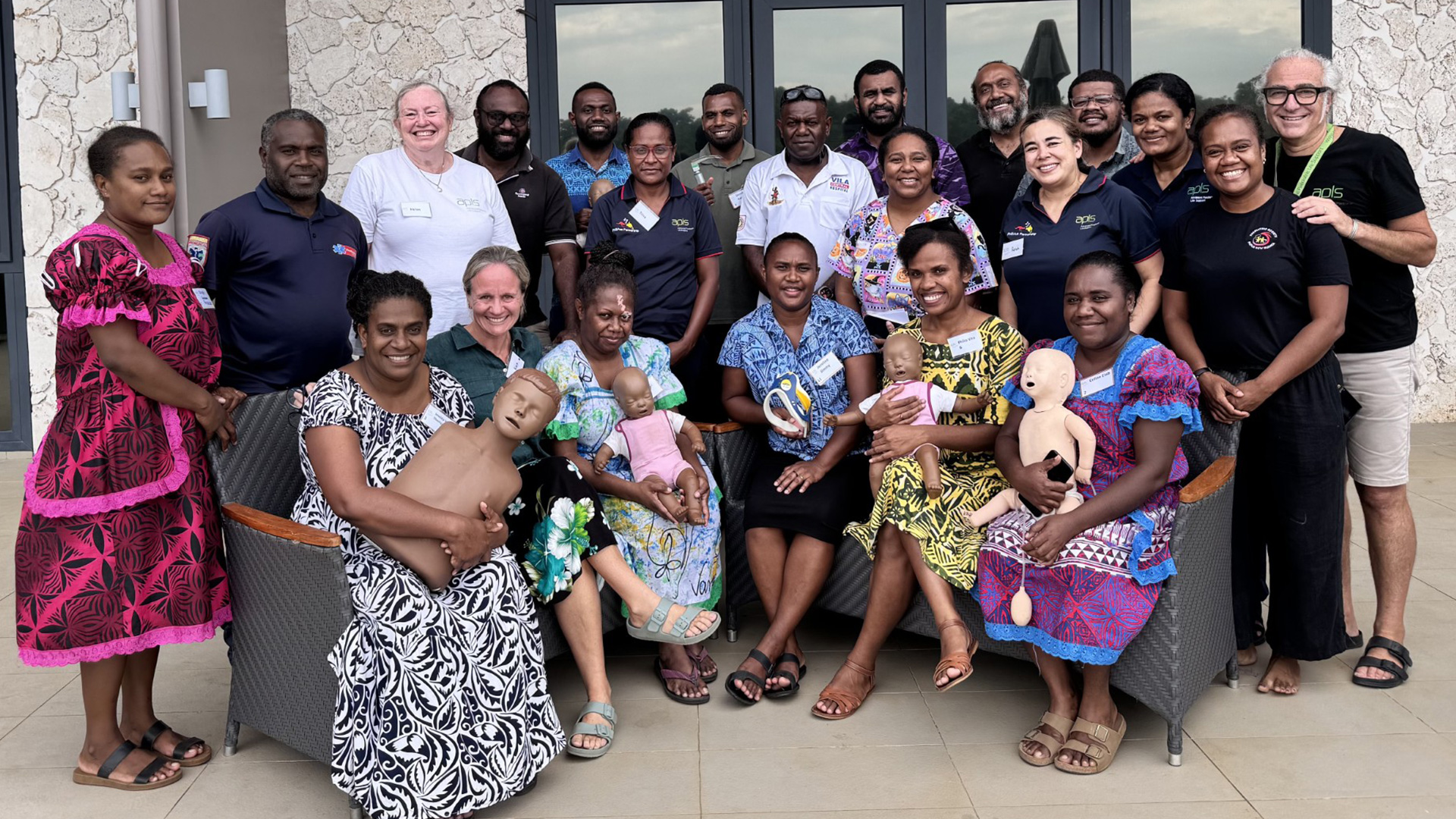
An APLS team has just returned from Port Vila in Vanuatu, where we ran a day of faculty development, a 3 day APLS and a 1 day PLS course over 5 days.
This was our 3rd visit to Vanuatu. Although we haven’t run a GIC in Vanuatu, several Ni-Van clinicians have done a GIC in Fiji or PNG, whilst training there.
Four of us travelled from Australia, and our faculty included 4 local instructors, an instructor from the Solomons and coordinator from Fiji. The coordinator mentored a local ED Nurse Practitioner.
Running courses overseas is fun but challenging. We had quite a few hiccups, including the fact that 4 out of 6 iPads didn’t arrive with us until the end of Day 1 of the APLS, so we had to go ‘old school’ and hold up images of VF and asystole during scenarios!
APLS is involved in teaching in several countries in our region, including Fiji, Solomon Islands, Timor-Leste, Vanuatu, Papua New Guinea, Cambodia, Vietnam, Maldives and Sri Lanka. To become an international instructor, you must have instructed in Australia for at least 5 years (10 courses) and continue to be actively involved in courses back home. This is important for credibility and currency.
Some trips are funded (by DFAT or other organisations), but for many, instructors pay for their own travel, accommodation and expenses. Many doctors use their CME funding, but some states are not as flexible as others in terms of allowing this or approving leave. The International Programs Committee aims to provide support for nurses, coordinators and educators to join international faculties where possible.
Given the unpredictability of things when we’re away from the support of our APLS office team and experienced Australian coordinators, it’s essential that international instructors can work autonomously and flexibly, and they really need to be good listeners, patient communicators and reflective facilitators/learners.
There’s more info on the APLS website, and applications for consideration as an international instructor are here.
Mike Starr
Chair
International Programs Committee
The end of 2025 marked the completion of my first year as Chair of the PLS Course Committee (PLSCC).
I stepped into the role following Dr Stephen Teo, whose leadership has had a significant and lasting impact on the PLS program. We are grateful for Stephen’s continued involvement on the Committee, where he generously supports the team with his extensive experience and expertise in PLS.
Future planning for the PLS program is now underway. The Committee, CEO and APLS Board recognise the unique value of our one-day PLS program with the endorsement of the PLS Growth Strategy, acknowledging the PLS courses’ role in upskilling health professionals in the acute management of paediatric emergencies.
In January 2026, we were delighted to welcome Meredith Gunn as PLS Course Operations Coordinator, bringing valuable APLS expertise from her roles in the equipment team and course coordination, to support the program.
We also warmly welcomed Dr Shaun Casey as a new member of the PLS Course Committee.
In 2026, we 're excited to launch an online PLS Community of Practice (CoP), a quarterly MS Teams forum open to PLS Directors, Instructors and Coordinators. This will create a space to connect, learn, share experiences and discuss all things PLS.
If you're involved in the delivery of PLS courses as an instructor, provider or coordinator, we'd love to have you involved. Please follow the link or scan the QR code above to register your interest in attending, or contact Meredith directly.
A PLS Development Day was held in June 2025, continuing our focus on supporting and developing our faculty.
Since the first PLS Instructor Day in 2017, PLS Australia has continued to evolve. The introduction of online instructor development modules has been an important step in supporting PLS faculty.
The PLS Provider Hub continues to support instructor development, learning resources and course materials.
All PLS providers can access this hub via My APLS.
The APLS Education Team has also commenced a review and update of all PLS course resources, including the new addition of the PLS Course Directors Guide.
In 2025, 66 PLS courses were delivered across Australia to Medical, Nursing and Paramedic candidates.
As of February 2026, 36 PLS courses have already been scheduled through partner hospitals. We anticipate a further 30-40 courses will be delivered by the end of the year, reflecting growth and demand for the program.
We are excited about the future of the one-day PLS program and the continued strength of our PLS community.
For further information regarding PLS courses or to express interest in getting involved in our CoP, please contact Meredith, PLS Course Operations Coordinator via meredith.gunn@apls.org.au.
Shelley Dutton
Chair
PLS Course Committee
Across the organisation, there is clear momentum. The upcoming Paediatric Acute Care Conference 2026 in New Zealand represents more than just a conference, rather it is a coming together of a trans-Tasman community committed to improving paediatric care. The theme of connection and flow is evident not only in the program, but in how we continue to work together across borders, disciplines, and roles.
Our course portfolio continues to strengthen through thoughtful, incremental improvements. The work of the Course Development Committee highlights how seriously we take feedback, evidence, and the learner experience. Changes to course structure, online learning, and workshop delivery are not made lightly, they are the result of careful consideration and a shared commitment to relevance and quality.
Equally, it is encouraging to see the continued growth of our one-day PLS program, supported by a clear strategy and expanding national demand. The launch of a PLS Community of Practice is a particularly important step towards creating space for connection, shared learning, and ongoing development beyond the classroom.
Internationally, our work continues to demonstrate both impact and resilience. Delivering courses in environments such as Vanuatu reinforces the importance of adaptability, strong faculty capability, and genuine partnership with local clinicians. These programs are not without challenge, but they are central to our mission and reflect the very best of what APLS stands for.
At the same time, there is a clear focus on strengthening our faculty ecosystem. The evolution of the Faculty Development Committee, clearer pathways for involvement, and greater transparency in progression all signal a maturing organisation that is investing in its people. We look forward to sharing more about this in the very near future.
What stands out most across all of this is balance. We are not chasing change for its own sake. Instead, we are building deliberately – refining what works, addressing what doesn’t, and remaining open to new ideas. Whether it is improving debriefing practice, advancing thinking in paediatric trauma, or enhancing how we support faculty, the direction is clear: continuous improvement grounded in purpose.
As we look ahead towards PAC 2026, ongoing program growth, and ultimately our 30-year milestone in 2027, there is a strong sense of confidence in where APLS is heading.
Thank you for the role each of you plays in this. The strength of APLS has always been its people, and that continues to be our greatest advantage.
Cameron Glover
Chief Executive Officer
APLS Australia
Submissions for oral and poster presentations at the forthcoming PAC Conference are now open. If you have some research you would be interested to present, head to PAC 2026 Call for Abstracts for details on how to submit. EOIs close 15 July.
APLS has welcomed around 15 new course directors over the last 2 years. As part of the support process, we have been running an online Director's Forum every few months, in which new course directors can share their experiences and touch base with our education team and some experienced directors. With 3 sessions completed and very positive feedback, we aim to expand these sessions to offer a similar forum to all course directors later in 2026.
Instructor Request Forms: as part of an ongoing effort to streamline our pre-course communications to learners and faculty, you might see some changes shortly to this form. We do require all faculty members (local or interstate) to return this form to us, within 6 weeks of a course start date. Whether you're travelling interstate or not, please send us back your form as it helps us keep track of most course logistics (parking, dinner RSVPs, accommodation requests, dietaries etc.) – it's not just a travel form. We are in the process of reviewing all pre-course comms, so you can expect to see some positive changes soon.